
Loading article...
Slot ID: blog-post-top
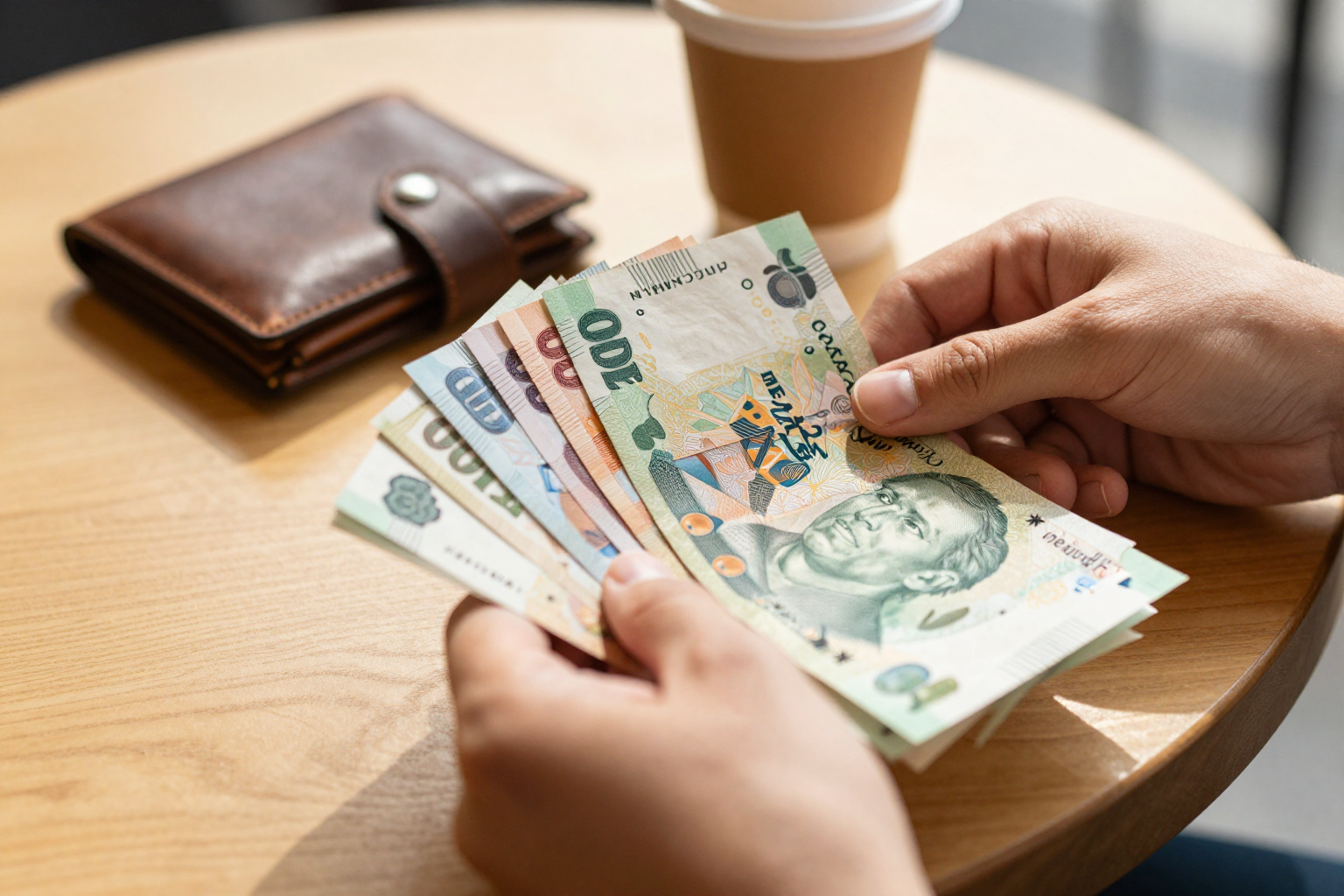
You're standing at a counter in Mexico City with 24,000 pesos in your hand, and someone tells you the rate is “about 19.” Is that good? Bad? You have no idea, because nobody ever taught you what the number should be.
That's the whole problem with converting pesos to USD. It's simple arithmetic buried under three layers of marketing. Once you know the order of operations, rate first, math second, fees third, you can judge any offer in about a minute and stop handing over $40 for nothing.
Here's the sequence, using real numbers you can swap for your own.
“Peso” is a word used by at least six countries. Mexican pesos (MXN) are what most people mean, and they're the easiest to convert. Philippine pesos (PHP) work almost identically. Argentine pesos (ARS) and Colombian pesos (COP) are a different story: in Argentina especially, the official rate and the street rate can differ by 20% or more, which changes the entire calculation.
The examples below use Mexican pesos. The method is identical no matter which one you've got. Only the number after the decimal point changes.
The mid-market rate, also called the interbank or mid rate, is the midpoint between what buyers and sellers are trading at globally. It's the honest baseline, and you can find it on Google, XE, or Reuters in about ten seconds.
Say it's 1 USD = 18.50 MXN. Write that on the back of a receipt or in your phone. Every offer you get from here on gets measured against it, and the gap between them is your real cost.
Two things worth knowing about that number:
You're selling pesos and buying dollars, so you divide. With 24,000 MXN at 18.50, that's 24,000 ÷ 18.50 = $1,297.30.
That figure is your ceiling, the most those pesos can possibly be worth. Whatever you actually receive will be less.
A mental shortcut that lands within a dollar: multiply pesos by 0.054. For 24,000 that's $1,296. For 5,000 pesos it's $270. For 1,000 it's $54. Good enough to catch a bad offer at a glance.
If you'd rather see the arithmetic worked through line by line, this step-by-step walkthrough of converting pesos to dollars with real numbers breaks down the same calculation in more detail.
Now the part that actually matters. Suppose the casa de cambio down the street quotes 19.10. That's higher than 18.50, which feels good, but for someone selling pesos it's worse, because it means a dollar costs you more pesos.
24,000 ÷ 19.10 = $1,256.54. The difference is $40.76, a markup of 3.2%. On a $1,300 transaction, that's the price of a decent dinner handed over for a service that took ninety seconds.
Run the same test on every quote. Subtract the offered rate from the mid-market rate, divide by the mid-market rate, and you have the real percentage cost. Nothing else about the offer matters until you've done that.
Most people compare two: the bank they already use and the kiosk closest to them. Both are usually the worst deals available. Realistic options, with typical all-in costs:
The reasoning is the same one behind converting Canadian dollars to USD without losing money on the rate. The currency changes, the traps don't.
The rate is only layer one. Layer two is a percentage commission some counters add on top, the small print that says “2% service charge applies to all transactions.” Layer three is the fee your receiving account charges, which is invisible when you hand over the cash and shows up a week later.
Ask three questions out loud before you agree to anything:
The euro-to-dollar market has the same three-layer structure, and this guide to EUR to USD conversion with real fees is a useful parallel if you want to see how those layers stack up somewhere else.
Nobody knows which way the rate goes next week, and anyone who claims otherwise is selling something. What you can control is exposure. Converting all 24,000 pesos on a Tuesday morning leaves you fully exposed to whatever happens that day. Splitting it into two or three transfers over a few weeks averages out the rate. You'll never get the best possible number, and you'll never get the worst.
For anything under about 5,000 pesos, splitting is more hassle than it's worth. Convert it and move on.
Here's what actually lands in your US account, using an 18.50 mid-market rate:
Same pesos, same day, same destination. The gap between the best and worst option is $115, roughly 9% of your money, spent on nothing at all.
The process is identical, but the PHP market behaves a little differently. Rates cluster around 1 USD = 56–58 PHP, spreads at physical exchange counters in Manila are often tighter than in Mexico City, and remittance services are brutally competitive because of the volume of overseas Filipino workers sending money home. If that's your situation, this seven-step breakdown of USD to PHP conversion covers the fees and timing in far more detail.
Next time someone quotes you “about 19,” you'll know within a few seconds whether that's generosity or a 3% haircut, and you'll already have three other options priced in your head.
Slot ID: blog-post-bottom