
Loading article...
Slot ID: blog-post-top
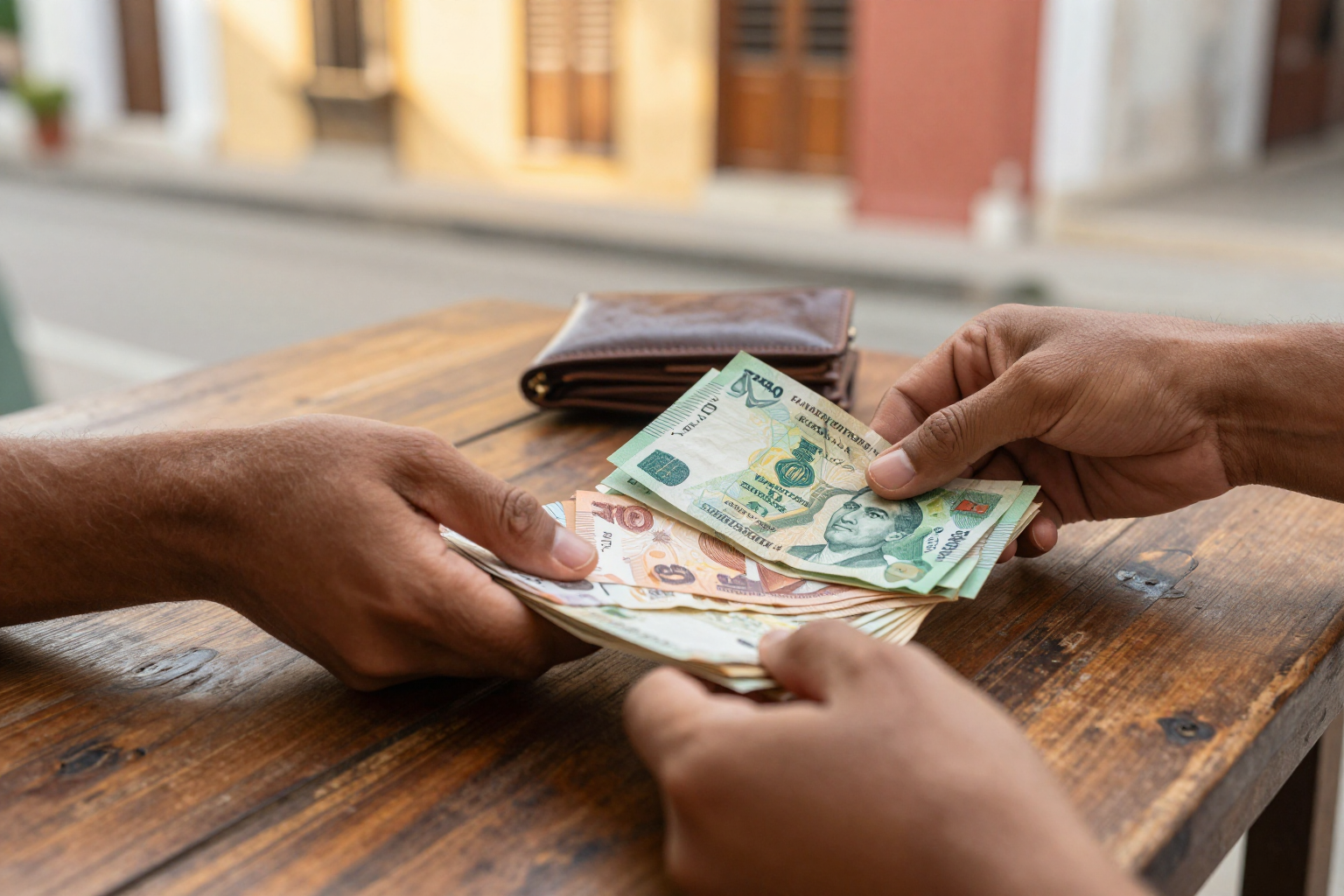
You've finished three weeks in Medellín, or wrapped a contract that paid in Colombian pesos, and now you're holding a stack of notes that are worth real money in New York but nothing at the coffee counter in El Dorado airport. Converting it shouldn't be hard. In practice, most people hand over 3% to 8% of their cash without noticing, simply because they accept the first rate they're shown.
Here's the process that avoids that, walked through with actual figures.
Nearly everyone who fumbles this stumbles on the same thing: which way the number runs. A quote of "4,000" means 4,000 Colombian pesos buys one US dollar. So a higher number means the peso is weaker and your dollars are worth more; a lower number means the peso has strengthened.
This matters because exchange counters in Colombia post two figures, and if you have pesos and want dollars, you're buying dollars, which means you get the worse of the two. On a board reading "Compra 3,880 / Venta 4,130," you're on the 4,130 side. It's the same trap that catches people out hunting for the rate you actually get on any currency pair, and it's the single most expensive misunderstanding in currency exchange.
The mid-market rate is the midpoint between the global buy and sell prices, with no spread built in. It's what Google, XE and Banco de la República will show you, and it's the only honest benchmark you have.
Check it on the day you're converting, not a week before. The peso moves more than most people expect. It traded near 3,850 in mid-2022, crossed 5,100 in November of the same year, and drifted back under 4,000 through 2024. A rate you saved in a notes app is worthless.
Say you're carrying 4,200,000 COP and the mid-market rate that morning is 1 USD = 4,000 COP. Divide:
4,200,000 ÷ 4,000 = $1,050
That $1,050 is your target. Everything below it is the cost of converting. Write the number down before you talk to anyone, because once you're standing at a counter with a queue behind you, "is this good?" becomes very hard to answer.
One quote tells you nothing. Three tells you what the market is doing that day. The realistic options in Colombia are:
Ask each one the same question: "If I give you 4,200,000 pesos right now, how many dollars do I walk out with?" That single question bypasses every confusing fee structure in the room.
Here's the same 4,200,000 COP against three real-world quotes. Mid-market is 4,000.
A city-centre casa de cambio quoting 4,130 gives you $1,016.95. That's $33 short of your target, roughly 3.1%. A fair price for a face-to-face counter with no paperwork.
The airport counter quoting 4,330 gives you $969.98. You've just paid $80, or 7.6%, for the privilege of not taking a taxi into town.
A digital provider charging 0.7% all-in lands you $1,042.65. That's a $7 cost, and it would be the obvious winner if the transfer didn't take a day or two to clear.
The arithmetic works identically in the other direction. If you're converting a few thousand dollars into pesos without losing money on fees, you're solving the exact same problem with the fraction flipped.
Three things show up on top of the number you were quoted.
A flat charge, usually $3 to $10 at a counter, sometimes waived for larger amounts. Ask, don't assume.
This is the real cost, and it's invisible. A counter offering "zero commission" has simply moved its margin into a worse rate. Compare the dollar payout to your target and the spread reveals itself.
If the dollars are landing in a US or UK account, an incoming wire can cost $15 to $25, and correspondent banks sometimes shave another slice off in transit. It's the mechanism behind getting quietly skimmed when converting $2,000 into another currency, and it's why the amount that arrives rarely matches the amount that left.
Colombia levies a financial transactions tax, the gravamen a los movimientos financieros, better known as the 4x1000, at 0.4%. Withdraw 2,000,000 COP from a cash machine and 8,000 COP disappears to the tax before the ATM operator's own fee, typically 10,000 to 20,000 COP, and your home bank's foreign transaction charge, often 3%, are added on top.
Two practical notes. First, take out fewer, larger amounts rather than several small ones, since the fixed fees repeat every time. Second, if you're crossing a border with more than USD 10,000 in cash, both Colombia and the US require you to declare it.
You're flying home with 2,000,000 COP, around $500. At a 4,130 counter rate you'd get $484. Before you bother, check the notes: Colombian exchange houses routinely refuse torn, taped or heavily worn bills, and a rejected note is worth nothing. Spend the odd 50,000 in the departure lounge instead.
Freelancers with a Colombian account have more room to manoeuvre than tourists. The most effective move is to compare a bank wire against a digital provider on the day, and to batch payments rather than converting every invoice the moment it lands. The fee-hunting method behind converting 50,000 Thai baht into dollars without losing $45 transfers directly here, currency aside.
Expect documentation. Banks and licensed platforms will typically ask for your invoice, contract or proof of the source of funds, and processing can take two to five business days. Have the paperwork ready before you initiate, or you'll be redoing the request next week at a different rate.
It can, more than with most currencies. The peso lost roughly 20% against the dollar between mid-2022 and that November peak, then recovered most of it over the following eighteen months. Someone who converted a $20,000 windfall in October 2022 got around 100 million pesos; a year later the same dollars would have bought roughly 79 million.
That volatility is exactly why guessing is a bad strategy. Nobody reliably calls the peso, and waiting for a better rate usually means holding a currency you can't spend. If you're converting more than about $5,000, split it across two or three conversions a few weeks apart. The extra fixed fees are negligible, the average rate you land tends to be reasonable, and you stop refreshing the exchange rate at midnight wondering whether to move.
Slot ID: blog-post-bottom