
Loading article...
Slot ID: blog-post-top
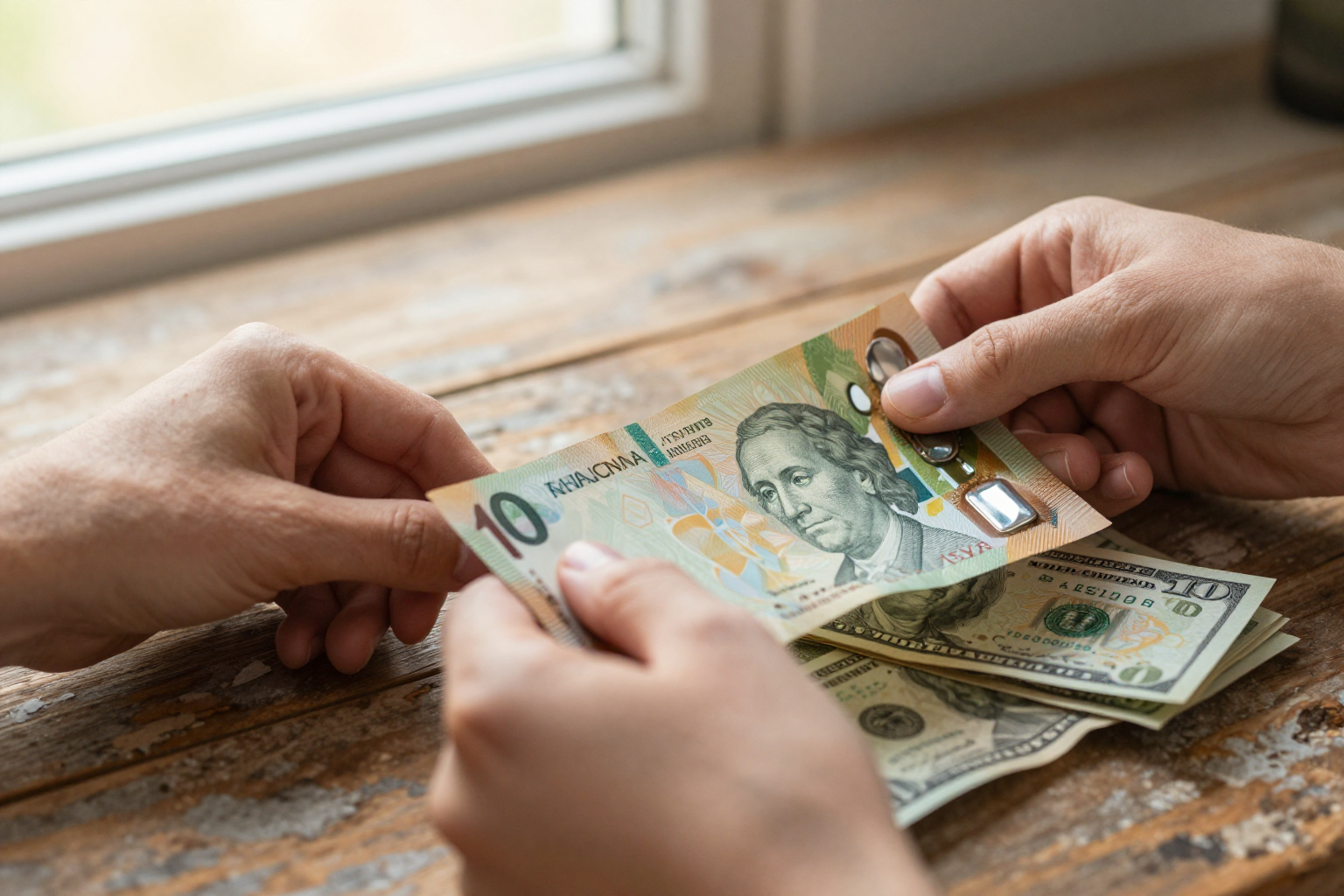
Maya lives in Hamilton and owes a US supplier $4,800 for a parts order. She opens her bank app, taps "convert," and sees a number that looks nothing like the 73 cents she spotted on Google that morning. By the time the transfer clears, she's out roughly $6,700 CAD for something she'd mentally priced at $6,530. That $170 gap is what this guide is about.
The number on Google, XE, or the Bank of Canada's site is the mid-market rate, also called the interbank rate. It sits halfway between what banks pay to buy Canadian dollars and what they charge to sell them. No ordinary customer gets it. It's still the only honest baseline you have, so start there.
As of a recent snapshot, the mid-market sits near 1 CAD = 0.7350 USD. Flipped around, that's 1 USD = 1.3605 CAD. Both describe the same moment. Canadian banks usually quote the second version — USD/CAD — which is why the "1.36" on your banking screen looks wrong when you're thinking in the other direction. It isn't wrong, it's just inverted.
Write the mid-market number down before you do anything else. Every option you look at from here gets measured against it.
Banks describe their cost as "a competitive rate" or "a small spread." Percentages hide the sting. Dollars don't.
Say you're converting $10,000 CAD. Mid-market would hand you $7,350 USD. Here's what you'd actually end up with:
Cheapest to most expensive on ten grand is a spread of about $150. On $100,000 it's $1,500. Identical transaction, different paperwork.
Don't compare marketing pages. Request actual quotes — most brokers publish one without a signup — and look only at the "you receive" figure in USD. If you're moving money the other direction later, the same discipline applies when converting USD back to CAD.
Back to Maya's $4,800 invoice. She needs to buy USD, so what matters is her provider's selling rate.
Same invoice, same day, $128 difference. Nothing about her bank's service was better — it was just the first app she opened.
Ask whether the headline fee includes the wire charge and any intermediary bank fee on the receiving end. A $15 sending fee on a $500 transfer is a 3% surcharge hiding in plain sight.
USD/CAD moves on a short list of things you can actually track: the price of West Texas Intermediate crude (oil is Canada's biggest export, so oil up usually means loonie up), the gap between Bank of Canada and Federal Reserve policy rates, two-year bond spreads, and plain risk appetite.
In a calm year, USD/CAD might wander between 1.32 and 1.39. In a rough one, it can punch through either edge inside a week. A 5% range sounds like free money until you try to trade it, and most people who wait for a better rate end up converting at a worse one out of frustration. The forces that push the Australian dollar around against the US dollar drive the loonie too — both are commodity currencies that get dumped when investors get scared.
For a one-off bill, convert when you need to. If you're moving money regularly, split it: convert a third now, a third in a month, a third in two months. You'll land close to the average and stop refreshing rate pages at midnight.
If the money is for a trip or a single bill, convert once and spend it. If you're a snowbird or you pay US vendors every month, open a real US dollar account — RBC, TD, and BMO all offer USD chequing in Canada, and you avoid paying the spread twice.
Above roughly $50,000, look at Norbert's Gambit. You buy an interlisted security in CAD on the TSX, journal it over to the US side of the same brokerage, and sell it in USD. Costs are two trade commissions, maybe $20 total, so $50 of expense on $100,000 instead of $1,500. It takes three to five business days and usually one phone call. Below $10,000, commissions and rate movement during the settlement window wipe out the benefit.
If mid-market is near 0.73, the shortcuts are simple: CAD to USD is roughly "multiply by 0.73," and USD to CAD is roughly "multiply by 1.37."
That's your mid-market estimate. Now shave off your provider's margin — 2.5% off $730 leaves $712, which is what a typical bank would hand you. On a $60 lunch bill in Vermont, the mental math is faster than any app.
The people who lose the least on a Canadian dollar to USD conversion aren't currency gurus. They just refuse to accept the first number they're shown, they quote the mid-market rate out loud before they tap anything, and they ask what the final USD figure will be, in writing, before they say yes. That habit is worth more than any forecast.
Slot ID: blog-post-bottom